



The DOE method, which stands for the Department of Environment method, was first published in 1975 and underwent a revision in 1988. This method is an improved version of the Road Note No. 4 or Grading Curve Method, originally designed for concrete pavements. The DOE method, unlike its predecessor, is versatile and can be applied to various concrete applications, including road construction. Additionally, it accommodates the use of fly ash (referred to as pulverized fuel ash or PFA in the U.K.) and GGBFS (Ground Granulated Blast Furnace Slag), which are supplementary materials commonly used in modern concrete.
The Road Note No. 4 method for designing concrete mix proportions, on the other hand, has its roots in extensive research conducted by the Road Research Laboratory in the United Kingdom. It was initially published as "Road Note No. 4" back in 1950. This method was widely adopted and extensively utilized worldwide until the 1970s. It is based on a set of standardized grading curves that provide specific limits for aggregate sizes, particularly for aggregates ranging from 20 mm to 40 mm.
In response to advancements in concrete technology and to provide a more versatile and up-to-date approach, the Building Research Establishment of the Department of Environment (DOE) in the United Kingdom introduced the DOE method. This newer method was developed to replace the Road Note No. 4 method and offers improved flexibility for concrete mix design.
- (i) Type of Cement.
- (ii) Type of aggregates (crushed or uncrushed) for both coarse and fine aggregates.
- (iii) Sp. gravity of coarse and fine aggregates in SSD condition.
- (iv) Absorption characteristics of both coarse and fine aggregates.
- (v) Percentage passing of 600 microns for fine aggregates.
| Material | Quantity (kg) |
|---|---|
| Cement | - |
| Fly Ash | - |
| Free Water | - |
| Fine Aggregate (SSD) | - |
| Coarse Aggregate (SSD) | - |
| Material | Quantity (kg) |
|---|---|
| Cement | - |
| Fly Ash | - |
| Adjusted Water | - |
| Adjusted Fine Agg. | - |
| Adjusted Coarse Agg. | - |
Concrete mix design form
| Stage | Item | Reference or calculation |
Values |
|---|---|---|---|
| 1 | 1.1 Characteristic strength | Specified |
{
30 N/mm² at 28 days
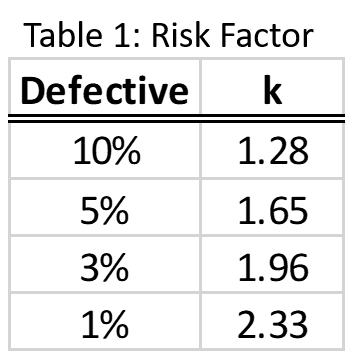
Proportion defective 5 %
|
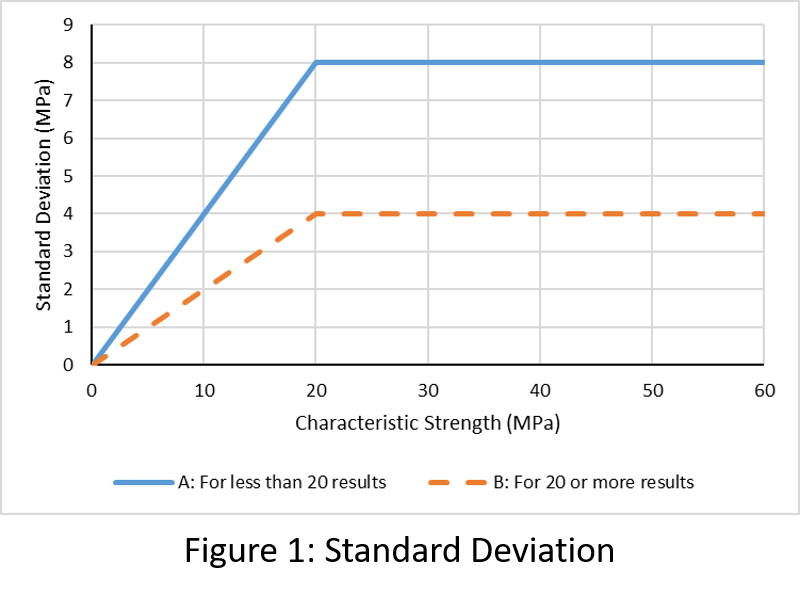
| 1.2 Standard deviation | Fig 3 | N/mm² or no data 8 N/mm² | |
| 1.3 Margin | C1 or Specified |
(k = 1.64 ) 1.64 × 8 = 13 N/mm² | |
| 1.4 Target mean strength | C2 | 30 + 14 = 44 N/mm² | |
| 1.5 Cement strength class | Specified | 42.5/52.5 + pfa | |
| 1.6 Aggregate type: coarse Aggregate type: fine |
Coarse: Crushed/uncrushed Fine: Crushed/uncrushed |
||
| 1.7 Free-water/cement ratio | Table 2, Fig 4 | 0.48 | |
| 1.8 Maximum free-water/ cement ratio |
Specified |
0.65
Use the lower value
0.48
|
|
| 2 | 2.1 Slump or Vebe time | Specified | Slump 30-60 (Vebe 3-6s) mm or Vebe time s |
| 2.2 Maximum aggregate size | Specified | 20 mm | |
| 2.3 Free-water content | Table 3 |
180
kg/m³
|
|
| 3 | 3.1 Cement content | C3 | 180 ÷ 0.48 = 375 kg/m³ |
| 3.2 Maximum cement content | Specified | - kg/m³ | |
| 3.3 Minimum cement content | Specified | 275 kg/m³ | |
|
use 3.1 if ≤ 3.2
use 3.3 if > 3.1 375
kg/m³
|
|||
| 3.4 Modified free-water/cement ratio |
-
|
||
| 4 | 4.1 Relative density of aggregate (SSD) |
2.6 known/assumed | |
| 4.2 Concrete density | Fig 5 |
2375
kg/m³
|
|
| 4.3 Total aggregate content | C4 |
2375 - 375 - 180 =
1820
kg/m³
|
|
| 5 | 5.1 Grading of fine aggregate | Percentage passing 600 µm sieve | 45 % |
| 5.2 Proportion of fine aggregate | Fig 6 | 37 % | |
| 5.3 Fine aggregate content | C5 |
{
1820 × 0.37 =
673
kg/m³
|
|
| 5.4 Coarse aggregate content |
{
1820 - 673 =
1147
kg/m³
|
||
| Quantities | Cement | Water | Fine aggregate | Coarse aggregate (kg) | ||
|---|---|---|---|---|---|---|
| (kg) | (kg or litres) | (kg) | 10 mm | 20 mm | 40 mm | |
| per m³ (to nearest 5 kg) | 375 | 180 | 673 | 380 | 767 | - |
| per trial mix of 1 m³ | 375.0 | 180.0 | 673.0 | 380.0 | 767.0 | - |
Items in italics are optional limiting values that may be specified (see Section 7).
Concrete strength is expressed in the units N/mm². 1 N/mm² = 1 MN/m² = 1 MPa. (N = newton; Pa = pascal.)
The internationally known term 'relative density' used here is synonymous with 'specific gravity' and is the ratio of the mass of a given volume of substance to the mass of an equal volume of water. SSD = based on the saturated surface-dry condition.
Additional mix design form for Portland cement/pfa concrete
| Stage | Item | Reference or calculation |
Values |
|---|---|---|---|
| 1 | 1.1 – 1.4 | ◀─────────────── On standard form ───────────────▶ | |
| 1.5 Cement strength class | Specified | 42.5/52.5 + pfa | |
| 1.6 | ◀─────────────── On standard form ───────────────▶ | ||
| 1.7 Free-water/cement ratio | Table 10, Fig 4 |
W/(C + 0.30F) =
0.48
|
|
| 1.8 | Transferred to 3.8 | ||
| 2 | 2.1 – 2.2 | ◀─────────────── On standard form ───────────────▶ | |
| 2.2a Proportion of pfa | Specified | p = 30 % | |
| 2.3 Free-water content | Table 9 |
180 - 20 =
160
kg/m³
|
|
| 3 | 3.5 Portland cement | C6 |
C =
296
kg/m³
|
| 3.6 pfa content | C7 |
F =
127
kg/m³
|
|
| 3.1 Total | — |
(C + F) =
423
kg/m³
|
|
| 3.2 – 3.4 | ◀─────────────── On standard form ───────────────▶ | ||
| 3.7 W/(C + F) | C8 | 160 ÷ 423 = 0.38 | |
| 3.8 (1.8) Maximum free-water/ cement ratio |
Specified | = 0.65 | |
| 4 | 4.1 – 4.2 | ◀─────────────── On standard form ───────────────▶ | |
| 4.3 Total aggregate content | C9 |
2400 - 423 - 160 =
1817
kg/m³
|
|
| 5 | 5.1 – 5.4 | ◀─────────────── On standard form ───────────────▶ | |
| Quantities | per m³ | per trial mix of 1 m³ |
|---|---|---|
| (to the nearest 5 kg) | ||
| Cement (kg) | 296 | 296.0 |
| pfa (kg) | 127 | 127.0 |
| Water (kg) | 160 | 160.0 |
| Fine aggregate (kg) | 636 | 636.0 |
| Coarse aggregate: | ||
| 10 mm (kg) | 395 | 395.0 |
| 20 mm (kg) | 786 | 786.0 |
| 40 mm (kg) | - | - |
Note: Pulverised-fuel ash (pfa) to comply with BS 3892:Part 1.
Concrete strength is expressed in the units N/mm². 1 N/mm² = 1 MN/m² = 1 MPa. (N = newton; Pa = pascal.)
The internationally known term 'relative density' used here is synonymous with 'specific gravity' and is the ratio of the mass of a given volume of substance to the mass of an equal volume of water. SSD = based on the saturated surface-dry condition.